
Thank you for taking the time to fill out our form. We will be in contact with you in the next 48-72 hours. in the meantime, check out our faq to learn more about how canine rehabilitation can help your pup!
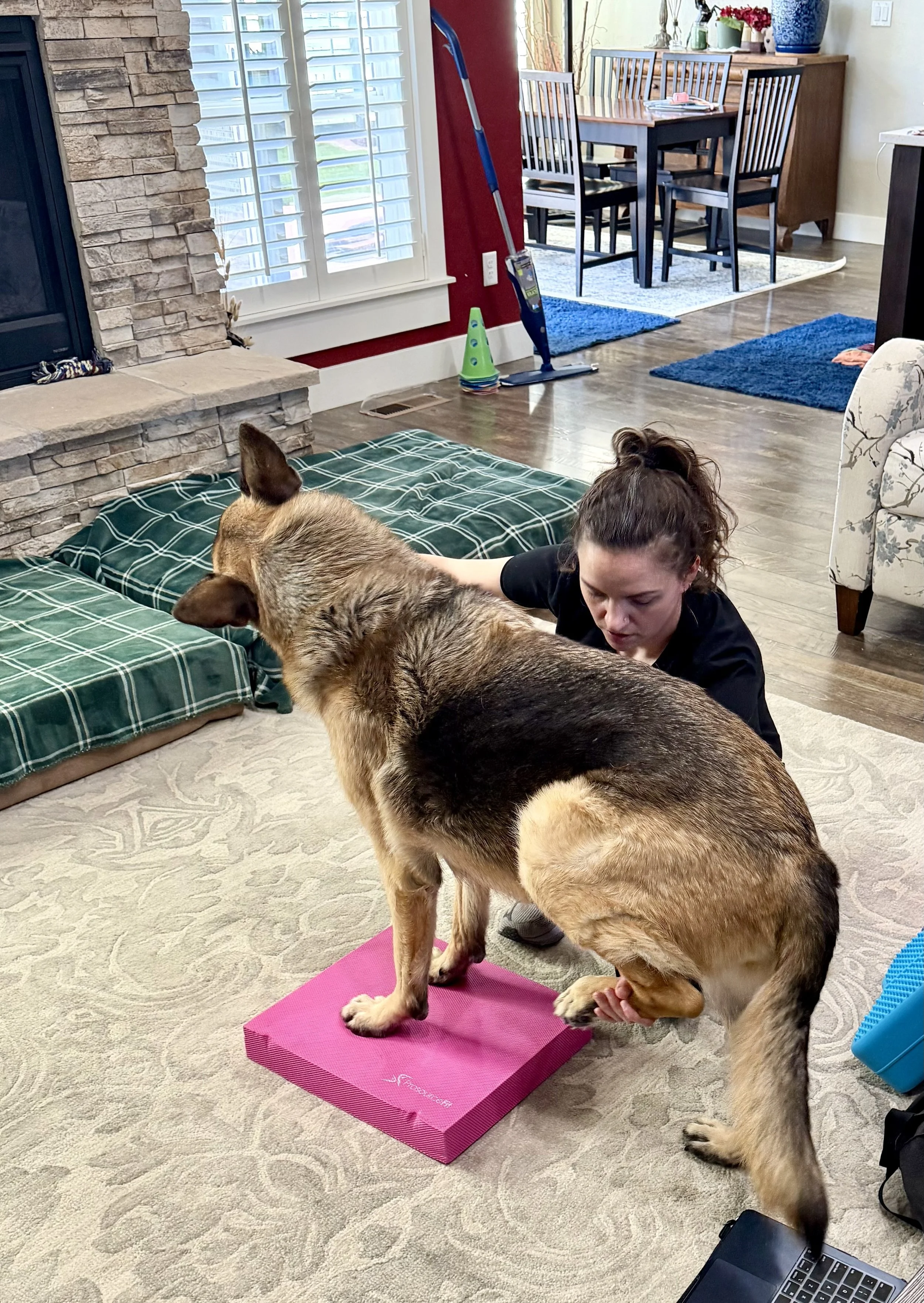
What sets Wild Stride Rehab apart?
Tailored, not templated care. Your dog’s treatment plan will be made just for them. Every dog has different needs and their care should follow suit.
Gentle, low-stress approach. We want your dog to be as comfortable as possible so they’re not only willing to participate but excited for their rehab. As such, we take the time to build trust, especially with our nervous pups, and avoid forceful handling or techniques.
Your voice matters. At Wild Stride Rehab, we believe in dogs living life to the fullest. They’re your early morning walk partners, trail companions, and everyday adventure buddies. When injury, surgery, or age slows them down, it can feel like a piece of those adventures is missing.
Wild Stride Rehab was created to help dogs regain strength, mobility, and confidence so they can get back to the life they love. You want to keep your dog by your side as long as possible, and that goal is what drives rehab at Wild Stride— no matter what your personal adventures look like. We also recognize you know your dog best, so we take the time to gain a full understanding of your concerns and your pup’s issues.
Expert care every visit. Every session is with a Doctor of Physical Therapy certified in canine rehabilitation. no hand offs. So we can continuously monitor your pup’s condition and modify treatments or techniques as needed.
Payment options. We offer payment plans so that you can pick what’s best for your budget.
Questions we’d be asking too…
-
Some signs that your dog is experiencing discomfort or weakness and could benefit from physical therapy include:
slowing down on walks or hikes
difficulty getting up
limping or stiffness
reluctance to jump, run, or climb stairs
dragging or scuffing their feet
frequently changing positions
stumbling or difficulty with balance
sudden behavioral changes
-
Absolutely! In the same way that humans can benefit from physical therapy to mitigate the effects of getting older, your dog can too.
Therapeutic modalities and hands-on treatments can help reduce aches and pains associated with aging, while progressive exercise can improve strength and stability to support their joints.
-
Yes.
Surgery addresses the actual physical structure that was injured. However, it doesn’t address the muscle atrophy and lack of strength from necessary crate rest or mobility limitations that can result from your dog not wanting to use the repaired area.
That’s where physical therapy comes in! We focus on improving mobility, getting them to use the repaired body part normally, strengthening and returning to normal activity the right way where your dog’s body is prepared.
Dogs are very good at finding the path of least resistance and will compensate their way through life. You don’t want to have gone through that whole process of surgery only to end up with more issues down the line!
-
Yes.
Every treatment plan is tailored specifically to your dog’s condition, age, and current activity level/ability to ensure therapy is both safe and effective.
-
Our initial evaluation is 75-90 minutes long to give plenty of time for a full history, examination, and their first treatment.
Subsequent sessions are around 45-60 minutes long and will include any treatments deemed necessary and appropriate.
-
There are a number of benefits to having an in-home service!
Less time commitment from you, which means less time out of your busy schedule!
No need to manage getting your dog in/out of the car, especially if they’ve recently had surgery.
Your dog doesn’t have the typical anxiety that can be associated with vet clinics. They get to stay in the comfort of their own home.
We can directly assess your home environment and give instruction on how to navigate both home exercises and daily life.
-
Correct. Though this doesn’t mean your pup receives anything but the best care.
While under water treadmills (or hydrotherapy) can be helpful in some specific instances, we find it’s not ideal for the vast majority of dogs in rehab.
The buoyancy effect of water in the treadmill works to reduce the effect of gravity by off-loading a dog’s limbs. But dog’s live their normal lives with full gravity, so we prefer to rehab in the same conditions. We have other ways of off-loading particular joints as needed and appropriate without under loading your dog’s entire body.
In addition, while water resistance can indeed have a strengthening effect, it only allows movement in one plane—forward to backward. But again, normal daily life isn’t lived in one plane of motion, so we want to exercise in all directions.
We are more than happy to discuss the benefits vs limitations of hydrotherapy further, so feel free to reach out!
-
A lot of dog’s can be nervous with physical examinations or even just new people in general. That’s perfectly okay!
The length of our initial evaluation is designed with this in mind. We start off chatting to let your dog get comfortable with us on their own terms. Then the physical examination is done at your dog’s pace. We aren’t trying to force anything they’re too uncomfortable with because we want your dog to have fun with physical therapy!
-
Yes.
For continuity of care and to be compliant with Idaho statute 54-2104 (2)(p), we require a vet referral prior to initial evaluation. This allows your veterinarian to establish the need for therapy and to manage medical conditions while we focus on our area of expertise- biomechanics, movement science, therapeutic modalities, hands-on treatments, and progressive exercise programs along with education to help you take an active role in your pet’s recovery.
Establishing this veterinarian-therapist-client relationship allows for open communication and helps address your pup’s needs in the most efficient, effective, and comprehensive way. We are all on “Team Fido!”
You can find a PDF of our veterinary referral form at the bottom of every page or your veterinarian can fill out the online form via our Veterinarians page.
-
The first step is easy! Just shoot on over to our Contact page to fill out some quick information about your dog. From there, we will reach out to you for next steps.